


Over the last decade, financial institutions have invested heavily in digital transformation. Core banking platforms have been upgraded, customer portals have become digital-first, cloud adoption has accelerated, and AI has become a boardroom priority.
Yet many organizations with 100–2,000 employees still face the same daily operational reality:
- Loan officers manually follow up on missing documents.
- Underwriters switch between multiple systems to complete a single case.
- Compliance teams spend hours gathering information already stored elsewhere.
- Claims processors re-enter the same customer information across applications.
- Operations managers rely on spreadsheets to understand today’s workload.
- Customer service representatives email internal teams because systems don’t communicate.
These aren’t technology problems—they’re workflow problems.
Many financial organizations believe the next investment should be AI. In reality, the greatest operational gains often come from reducing the number of manual handoffs, disconnected systems, and repetitive tasks that consume employees’ time.
Organizations that simplify workflows before expanding AI initiatives are seeing measurable improvements in processing times, operational efficiency, customer satisfaction, and employee productivity.
The question executives should be asking in 2026 isn’t:
“Where should we implement AI?”
It’s:
“Why does so much work still depend on people coordinating between systems?”
Digital Transformation Didn’t Eliminate Manual Work
Digital transformation successfully digitized many customer interactions.
Customers can now:
- Apply for loans online
- Submit insurance claims digitally
- Upload documents electronically
- Open investment accounts remotely
- Complete KYC verification online
- Track application status through portals
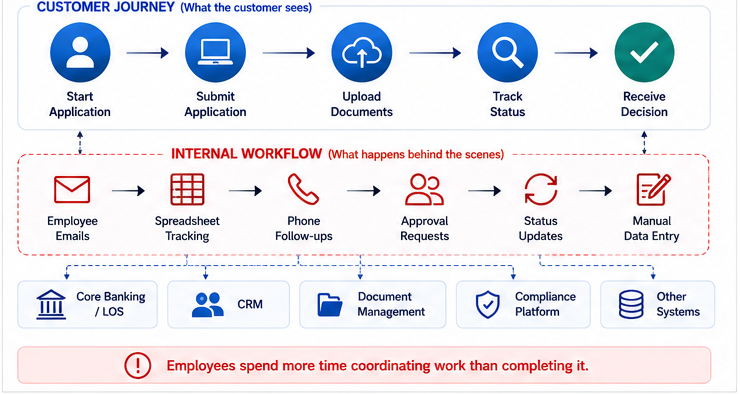
From the customer’s perspective, everything appears seamless.
Behind the scenes, however, the process often becomes surprisingly manual.
A single lending application might involve:
- Customer Portal
- Loan Origination System
- Credit Bureau Integration
- Document Management Platform
- CRM
- Compliance Platform
- Risk Assessment Software
- Excel
- Internal Approval Portal
Each system performs its role effectively. The challenge lies in the spaces between them.
Employees become the “integration layer” responsible for:
- Checking whether documents have arrived
- Sending reminder emails
- Updating statuses manually
- Copying information between systems
- Escalating stalled applications
- Coordinating approvals
- Tracking exceptions
- Following up with customers
Instead of focusing on customer relationships or complex decision-making, skilled professionals spend much of their day ensuring work moves from one system to the next.
This invisible operational effort rarely appears on executive dashboards—but it significantly affects costs, turnaround times, and customer experience.
Manual Workflows Are More Expensive Than Most Organizations Realize
When executives discuss operational costs, they typically focus on:
- Headcount
- Software licensing
- Infrastructure
- Vendor contracts
What often goes unnoticed is the cumulative cost of workflow friction.
Consider a loan processor handling 30 applications per week.
If each application requires:
- 8 minutes locating documents
- 6 minutes requesting missing information
- 5 minutes updating multiple systems
- 4 minutes checking approval status
- 7 minutes responding to internal emails
That’s 30 minutes of administrative coordination per application.
Across 30 applications:
15 hours every week are spent managing workflow—not evaluating loans.
Now extend that across:
- Mortgage operations
- Commercial lending
- Consumer finance
- Insurance claims
- Wealth management onboarding
- Compliance reviews
- Payment investigations
The result is thousands of hours devoted to moving work rather than completing it.
This hidden administrative effort often exceeds the time spent on value-added activities.
More Software Doesn’t Always Mean Better Operations
A common misconception is that operational inefficiencies result from insufficient technology.
In many mid-sized financial institutions, the opposite is true.
Departments often have access to capable systems:
- CRM
- ERP
- Core Banking
- Policy Administration
- Claims Management
- Lending Platform
- Identity Verification
- Customer Support
- Workflow Portal
- Analytics Dashboard
The issue isn’t the quality of individual applications.
It’s that each application was designed to optimize a specific function rather than the end-to-end business process.
As a result:
- A loan application might move through eight systems before approval.
- An insurance claim may require four departments to update status manually.
- Customer onboarding can involve several independent verification steps without centralized visibility.
- Employees become responsible for ensuring work progresses across disconnected applications.
Ironically, every new platform intended to improve efficiency can introduce another handoff, another login, another approval, or another status update.
Technology isn’t creating the inefficiency. Disconnected workflows are.
The Real Bottleneck Isn’t Decision-Making—It’s Coordination
When executives examine processing delays, they often assume employees need to make faster decisions.
Operational data frequently tells a different story. Many delays occur between decisions.
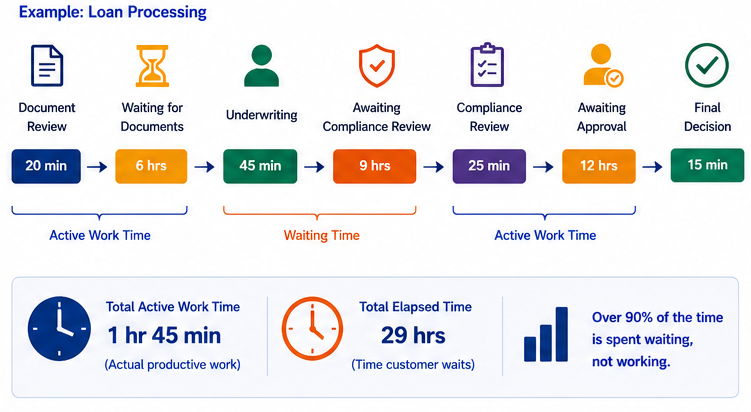
For example, a mortgage underwriter may complete a review in under an hour.
The application then waits:
- Three hours for document verification
- One day for compliance confirmation
- Six hours awaiting manager approval
- Several hours before customer notification
The decision itself wasn’t slow. The workflow surrounding the decision was.
These waiting periods are difficult to identify because no single system owns them.
Each department believes it completed its task on time. Yet the customer experiences a multi-day delay.
This “coordination gap” represents one of the largest opportunities for operational improvement.
Organizations that reduce unnecessary handoffs often improve turnaround times without increasing staffing or changing decision policies.
AI Cannot Fix a Broken Workflow
This is where many AI initiatives encounter resistance.
Organizations often ask:
- Can AI write emails?
- Can AI summarize documents?
- Can AI answer customer questions?
- Can AI generate reports?
These capabilities are valuable.
However, if work continues to move through fragmented processes, AI simply performs isolated tasks faster.
Imagine automating document summaries while employees still manually email those summaries to three departments.
Or deploying an AI chatbot while customer requests still require five internal approvals.
The underlying workflow remains unchanged. AI accelerates individual activities.Workflow optimization improves the entire process.
The most successful financial institutions increasingly view AI as one component of a broader operational strategy—one that includes process redesign, systems integration, automation, and end-to-end visibility.
When workflows are simplified first, AI becomes significantly more effective because it operates within a streamlined environment rather than compensating for operational complexity.
Across banking, insurance, lending, and wealth management, one pattern is becoming increasingly clear.
The organizations making measurable progress with AI aren’t necessarily investing the most in AI platforms.
They’re investing in making work flow more intelligently.
Instead of asking:
“Which AI tool should we buy?”
They begin with questions such as:
- Where do employees spend the most administrative time?
- Which processes generate the highest number of exceptions?
- Where are customers waiting the longest?
- Which activities require employees to switch between multiple systems?
- Where are approvals delayed?
- Which operational metrics are invisible today?
Once these answers are clear, technology decisions become far easier.
AI, automation, APIs, workflow orchestration, and integrations become tools that support a better operating model—not isolated technology projects.
A Practical Example: Loan Processing
Consider a regional lending organization processing several thousand consumer and commercial loan applications every month.
Their technology stack might include:
- Online application portal
- Loan Origination System (LOS)
- Credit bureau integrations
- Identity verification platform
- CRM
- Core banking platform
- Document management solution
- Compliance software
- Microsoft Teams
- Excel tracking sheets
On paper, this appears highly digital. Yet operations teams often experience a very different reality.
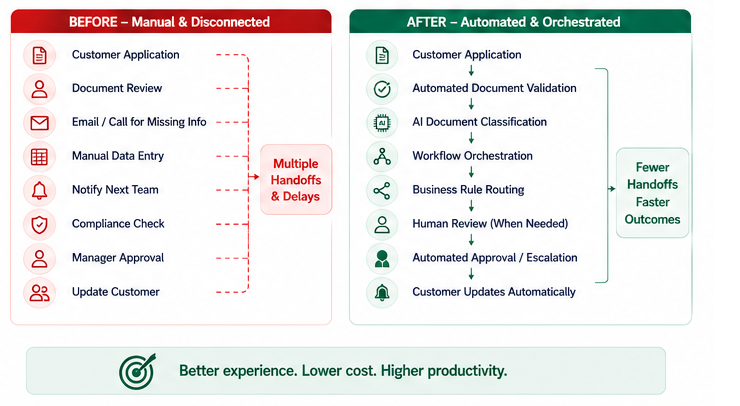
A typical application may involve:
- Customer uploads incomplete documentation.
- Operations manually review documents.
- Missing documents trigger email follow-ups.
- Staff update the CRM manually.
- Underwriters wait for document completion.
- Compliance performs independent verification.
- Managers approve through another portal.
- Operations notify customers manually.
- Staff update reporting spreadsheets.
Every step is reasonable. Collectively, they create dozens of manual touchpoints.
Now imagine redesigning the workflow. Instead of employees coordinating every activity:
- Required documents are validated automatically during submission.
- Missing information generates immediate customer notifications.
- Document status updates synchronize across systems.
- AI extracts relevant information from submitted files.
- Applications route automatically based on predefined business rules.
- Compliance receives only cases requiring review.
- Managers receive prioritized approvals instead of reviewing every application.
- Customers receive automated status updates throughout the journey.
The underwriter still makes the lending decision. Compliance still maintains oversight. Managers still approve when necessary.
What’s removed is the administrative coordination surrounding those decisions.
The outcome isn’t replacing expertise—it’s allowing experts to spend more time applying it.
The Same Pattern Exists Across Every Financial Sector
Although products differ, operational challenges are remarkably similar.
Insurance : Claims adjusters frequently spend valuable time:
- Searching for documents
- Requesting missing information
- Updating claim statuses
- Coordinating across departments
- Responding to repetitive customer inquiries
Most delays occur before claim evaluation even begins.
Wealth Management : Advisors increasingly face administrative burdens such as:
- Client onboarding
- Suitability documentation
- Compliance verification
- Portfolio administration
- Meeting preparation
- Follow-up documentation
These activities consume time that could otherwise be spent serving clients.
Investment Firms : Operations teams often coordinate:
- Trade confirmations
- Exception handling
- Settlement reconciliation
- Regulatory reporting
- Client communications
Many workflows still depend on manual intervention between systems.
Credit Unions : Smaller technology teams often support:
- Lending
- Member services
- Digital banking
- Compliance
- Core banking
- Reporting
Limited IT resources make workflow efficiency even more important.
NBFCs and Consumer Finance : Rapid growth frequently exposes operational weaknesses.
Applications increase.
Employees increase.
But workflows remain largely unchanged.
Organizations eventually discover that scaling headcount alone doesn’t resolve process complexity.
AI Delivers the Greatest Value When Employees Stay in Control
One misconception surrounding AI is that success depends on replacing human work.
In financial services, the opposite is generally true.
High-performing organizations are using AI to support decision-makers—not replace them.
Examples include:
Operations:
AI summarizes lengthy customer histories before service representatives engage.
Lending:
AI extracts relevant financial information from submitted documentation before underwriting begins.
Compliance:
AI highlights unusual activity requiring analyst attention instead of reviewing every transaction independently.
Claims:
AI organizes documentation and summarizes previous correspondence before adjusters begin evaluation.
Customer Service:
AI drafts responses while employees review and approve communications.
Notice the consistent pattern. Employees remain accountable. AI reduces preparation time.
Workflow automation eliminates repetitive coordination.
Human judgment stays at the center of every critical decision.
Operational Visibility Is Becoming a Competitive Advantage
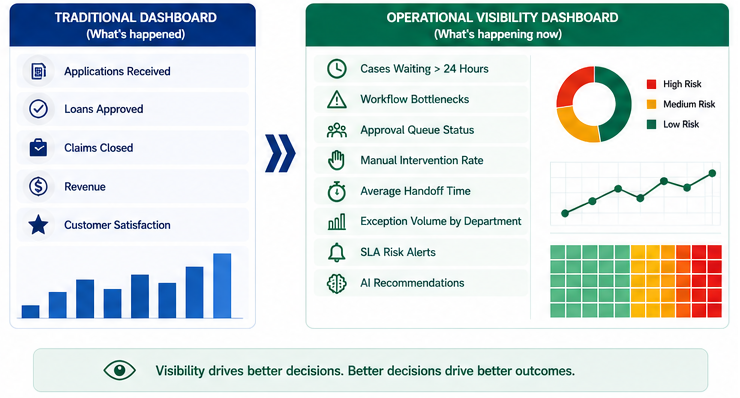
Many executives already receive dashboards showing:
- Number of applications
- Number of claims
- Customer satisfaction
- Revenue
- Approval rates
These are important metrics. But they rarely explain why work slows down.
Increasingly, leadership teams want answers to questions like:
- Which process is causing today’s backlog?
- Which department has the highest number of exceptions?
- How long are applications waiting between activities?
- Which approvals consistently exceed SLA?
- Which customer journeys experience the highest abandonment?
- Where are employees spending administrative time instead of serving customers?
These insights require visibility into workflows—not just business outcomes.
Organizations that understand how work actually moves can improve operations far more effectively than those measuring only final results.
Five Questions Every Executive Should Ask
Before approving another AI initiative, executive teams should ask:
1. Where are employees spending the most time coordinating work rather than completing it?
2. Which customer journeys require the highest number of manual handoffs?
3. How many different systems must employees access to complete a single process?
4. Which operational delays occur between departments rather than within them?
5. If workload increased by 30% tomorrow, would our current workflows scale without hiring significantly more staff?
These questions often uncover greater opportunities than evaluating individual AI use cases alone.
Final Thoughts
Financial institutions don’t have a shortage of technology.
Most already possess capable platforms, experienced employees, and years of digital investment.
The challenge lies in connecting those investments into workflows that move information efficiently, reduce unnecessary coordination, and provide leaders with real operational visibility.
AI is undoubtedly becoming an important part of that future.
But organizations seeing the strongest returns aren’t beginning with AI.
They’re beginning with workflow.
They simplify processes, reduce friction, improve visibility, and then introduce AI where it amplifies human expertise rather than compensating for operational inefficiencies.
For mid-sized financial institutions navigating growth, regulatory complexity, and rising customer expectations, that workflow-first approach may prove to be one of the most practical and sustainable competitive advantages of the coming years.
Complimentary Operational Workflow Analysis
Every financial institution has processes that consume more effort than they should—whether in customer onboarding, lending, claims processing, compliance, servicing, or back-office operations.
A structured workflow review can often uncover opportunities to:
- Reduce manual handoffs between teams and systems
- Improve visibility into operational bottlenecks
- Identify processes suitable for intelligent automation
- Streamline document-intensive workflows
- Integrate existing systems more effectively without replacing core platforms
- Introduce AI where it delivers measurable operational value—not just novelty
If you’re evaluating how to improve operational efficiency in 2026, an independent assessment of your current workflows can provide a practical starting point. Sometimes, the most impactful improvements come not from adding another system, but from helping the systems you already have work better together.
Contact Netforth Software Solutions
Contact us